日本語

Okinawa Goju-Ryu Karate-Do Kyokai — Branch Dojo, Nanjo City

Karate was born
in Okinawa.

Train where it began. Minei Karate Dojo in Sashiki-Tsuhako, Nanjo City, is a traditional Okinawa Goju-Ryu dojo where children and adults practice side by side — and where visiting karateka from overseas are welcome.

“Do not be struck by others. Do not strike others. The principle is peace without incident.”
— Chojun Miyagi, founder of Goju-Ryu
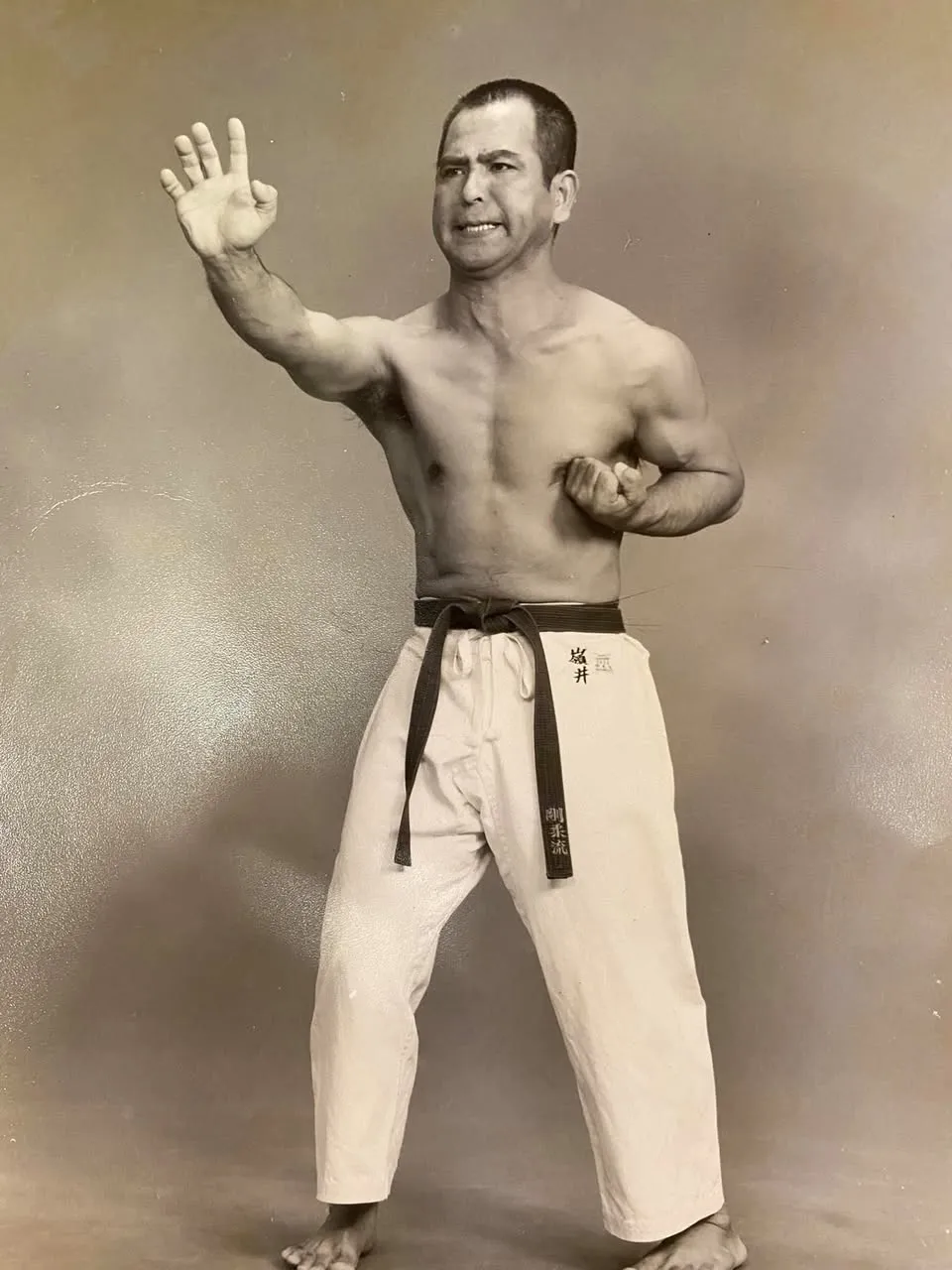
A master of Minei Karate Dojo in a Goju-Ryu stance

Master Nankō: “Tenzō” (date unknown)

Dojo Kun

Eight precepts of training.

The dojo precepts of the Okinawa Goju-Ryu Karate-Do Kyokai.

  • Be humble and polite.

  • Train according to your physical strength.

  • Practice earnestly and with creativity.

  • Be calm and swift.

  • Take care of your health.

  • Live a plain life.

  • Do not be too proud or modest.

  • Continue your training with patience.

Kata

Goju-Ryu Kata Names

The twelve kata of the Okinawa Goju-Ryu Karate-Do Kyokai.

Select a kata to read about it.

Kihon Kata

Sanchin三戦

Sanchin is the foundation of Goju-Ryu karate, in which correct posture and correct breathing matter more than anything else. It is said that in the old days students trained in Sanchin alone for three to five years, and that Goju-Ryu begins with Sanchin and ends with Sanchin. Because Sanchin conditioning tightens every part of the body, the strength of that tightening is confirmed by touching the body directly.

Kaishu Kata

Gekisai Ichi撃砕一

Gekisai Ichi was created in 1941 by Chojun Miyagi. It rationally systematizes attacking and defending techniques aimed at the upper, middle, and lower levels, and incorporates many of the characteristic features found throughout Goju-Ryu kata.

Kaishu Kata

Gekisai Ni撃砕二

Gekisai Ni was also created by Chojun Miyagi, and its form is nearly identical to Gekisai Ichi's. It contains more advanced techniques, however, such as the hooking block (kake-uke), the cat stance (neko-ashi-dachi), and the tiger-mouth strike (tora-guchi).

Kaishu Kata

Saifa砕破

Saifa has the shortest performance time of any kata, yet it is filled with demanding techniques: the hammer-fist strike (kentsui-uchi), the double-fist punch (morote-zuki), escaping (release) techniques, the reverse punch (ura-zuki), kicks, and intricate footwork.

Kaishu Kata

Seiyunchin制引戦

Seiyunchin is the only kata in the system with no kicking techniques. It includes back-fist strikes and applied variations, and makes heavy use of the straddle stance (shiko-dachi), making it a powerful conditioning kata for building the lower body.

Kaishu Kata

Shisochin四向戦

Shisochin is built largely around open-hand techniques, including the palm-heel push, the spear-hand strike (nukite), the fingertip strike, reverse joint-locking techniques (gyaku-kansetsu-waza), the reverse hooking block (ura-kake-uke), and the vertical elbow strike.

Kaishu Kata

Sanseru三十六手

Sanseru contains many practical attacking and defending techniques, such as the knife-edge kick (sokuto-geri), the chasing kick, leg-trapping techniques, and body shifting (tenshin), and it also teaches the subtlety of the circular block (ko-uke).

Kaishu Kata

Sepai十八手

Sepai contains many effective self-defense techniques suited to close-range combat, including striking techniques such as the reverse punch (ura-zuki), the back-fist strike (uraken-uchi), and the hammer-fist strike (kentsui-uchi), together with escaping (release) techniques.

Kaishu Kata

Kururunfa久留頓破

Kururunfa uses techniques such as the rolling block (kuri-uke), the crossing block (kosa-uke), and a hammer throw, blending movement as quick as a cat's with sticky, tenacious movement. Its distinguishing trait is bringing together, in a single decisive moment, actions that are otherwise difficult to finish with full commitment.

Kaishu Kata

Sesan十三手

If Sepai can be called the soft (ju) kata, then Sesan may fairly be called the furthest extreme of the hard (go) kata. Its movements are extremely forceful, and it tends to be favored by practitioners who excel at punching.

Kaishu Kata

Suparinpei壱百零八手

This kata, Suparinpei, is also known by the name Pecchurin. It is said to have originally consisted of three kata (upper, middle, and lower), of which this is the upper form. It is the longest kata in Goju-Ryu, employing a wide variety of techniques in all directions, with frequent changes of speed and tempo, giving it great depth and subtlety. It is a kata that offers a glimpse into the inner secrets of Goju-Ryu.

Heishu Kata

Tensho転掌

Tensho was created by Chojun Miyagi after he studied the Rokkishu of Southern Shaolin White Crane Boxing from Fuzhou, Fujian Province, and he made it a Heishu Kata. Its aim is to train ki, breath, and body by concentrating power in the tanden below the navel. Through correct posture and breathing, practitioners master various open-hand blocking methods and ways of striking with the palm heel.

About the dojo

Goju-Ryu, carried on in Sashiki.

Minei Karate Dojo is a branch dojo of the Okinawa Goju-Ryu Karate-Do Kyokai (OGKK), training in Okinawa — the birthplace of Goju-Ryu. The dojo is in Sashiki-Tsuhako, Nanjo City, where children and adults of the community train side by side.

Instruction is step by step, according to each student's age and strength, with character — courtesy, humility, consideration — at the heart of every practice.

Dojo Founder
the late Nanko Minei — 10th Dan, Hanshi
Dojo Head
Yasuyuki Minei — 8th Dan
More about the dojo

Lineage

  1. Chojun MiyagiFounder of Goju-Ryu
  2. Eiichi MiyazatoFounder of the OGKK
  3. Nanko MineiFounded Minei Karate Dojo
  4. Yasuyuki MineiDojo Head

Our history

A hard fist,
a gentle heart.

Receive softly; finish decisively. The name Goju — “hard and soft” — comes from mastering both in a single body.

Alongside daily practice in Sashiki, Minei Karate Dojo has left its mark through demonstrations and teaching in Japan and abroad. That path continues with the next generation.

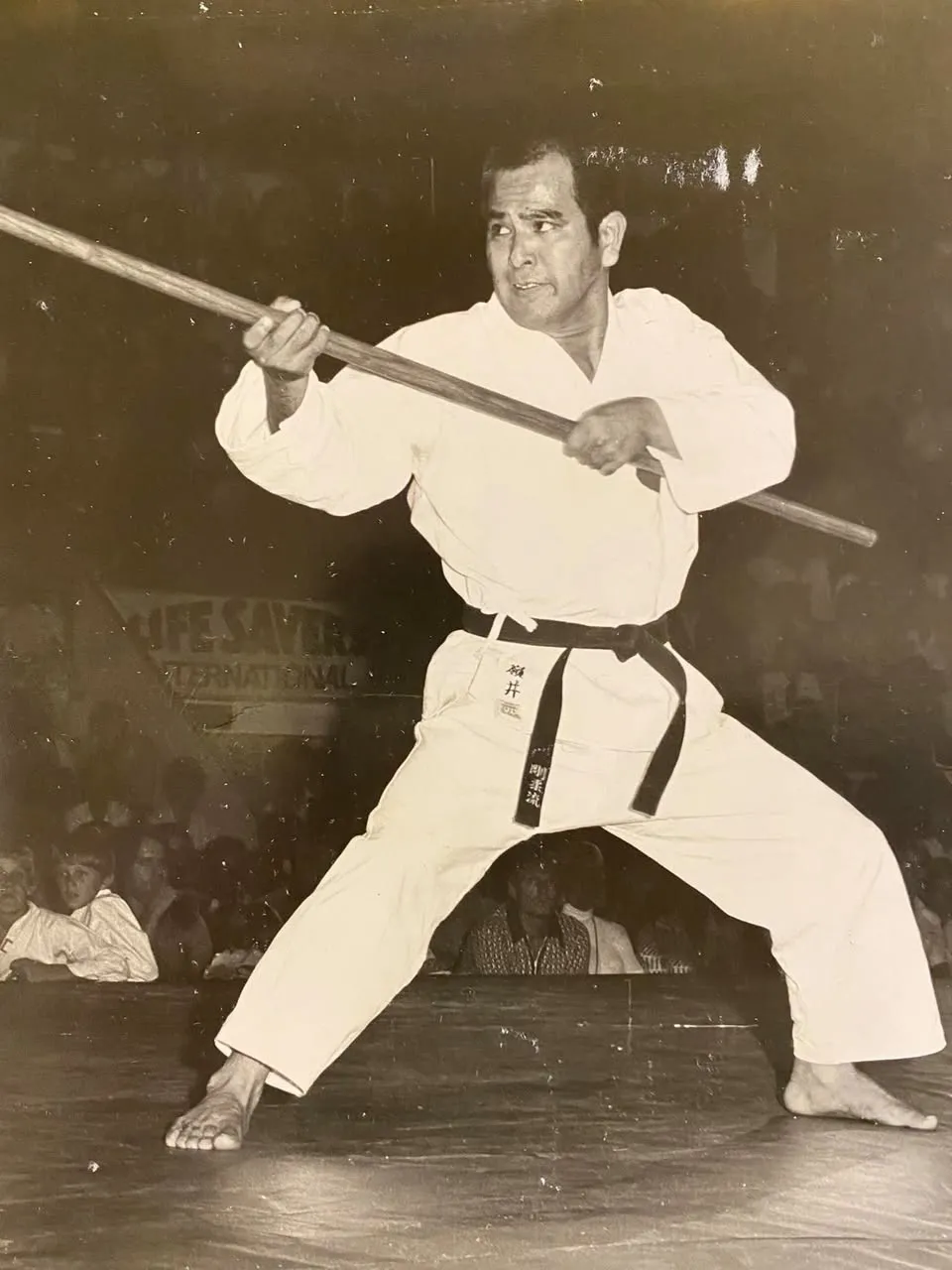
A master performing bojutsu at a demonstration
Master Nankō: Demonstration in the Republic of South Africa (1976)

Classes

Children and adults, one dojo.

Beginner Class (Children & Adults)

Practice days
Tue / Thu19:00–20:30Sun10:00–11:30
Monthly fee
¥4,000

We put character first: greetings, courtesy, humility and consideration for others. Those who wish can also take grading examinations and enter tournaments.
Adults' Advanced Class

Practice days
Tue / Thu20:30–22:00
Monthly fee
¥4,000

Training built on fundamentals and kata, at a pace that suits your age and condition — toward black belt and beyond.

Fees

Beyond the monthly fee.

A one-time fee on enrollment, plus annual insurance and registration.

Enrollment fee
¥5,000One-time, on enrollment
Sports safety insurance
Children's class¥800 / yearAge 64 and under¥1,850 / yearAge 65 and over¥1,200 / year
Junior Sports Club registration
Junior-high age and under¥500 / yearOkinawa Prefecture¥100 / yearNanjo City
Other
Fees for promotion and dan grading exams, tournament entry fees, etc.We will let you know as each comes up

Access & visits

Visitors are always welcome.

No dogi needed. Come in comfortable clothes on any practice day.

Dojo
Minei Karate Dojo
228 Sashiki-Tsuhako, Nanjo City, Okinawa 901-1414, Japan
Phone
070-5410-8428
Email
info@palma-one.com
Open in Google Maps (directions)
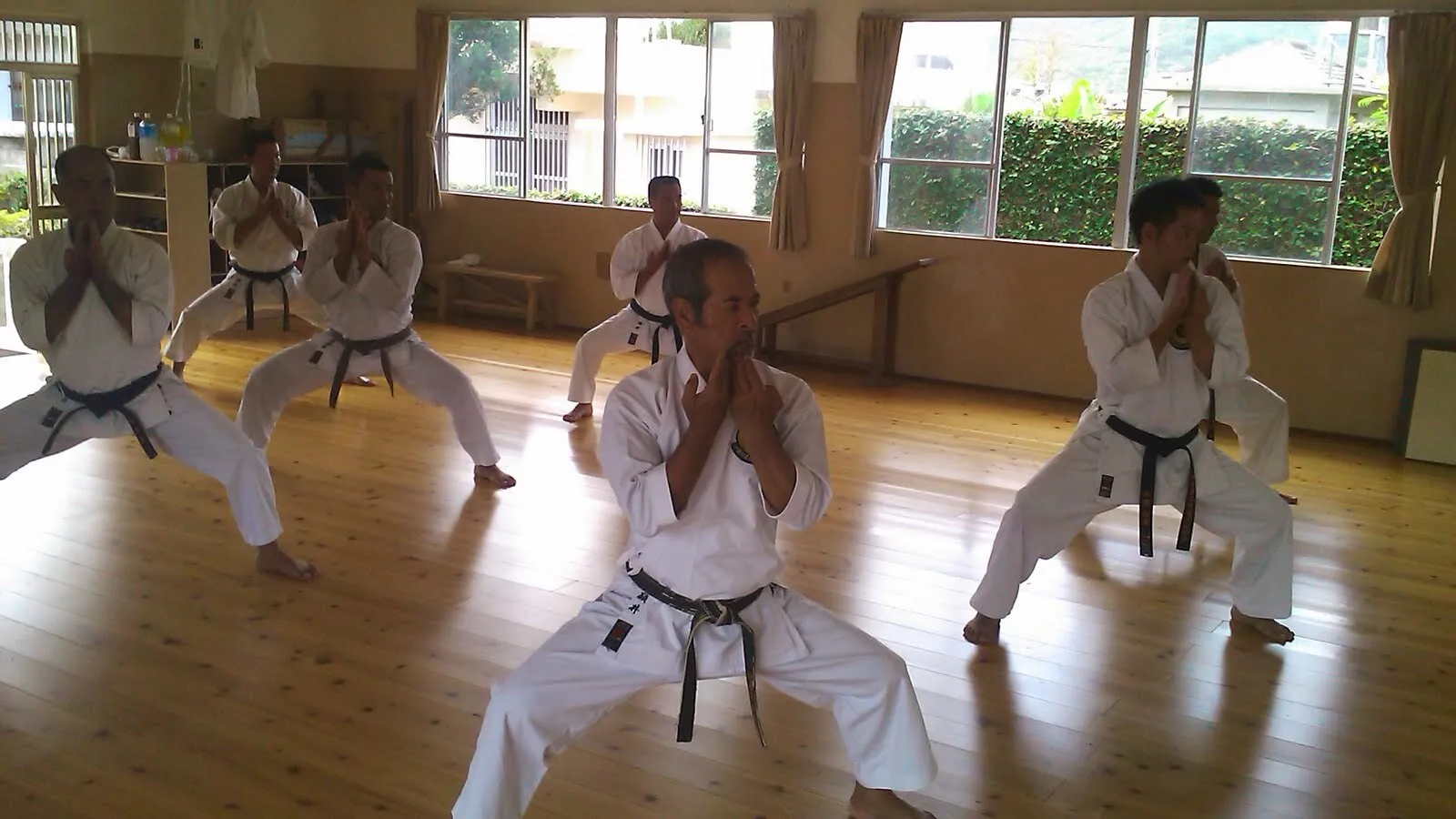
Kata practice at Minei Karate Dojo — students training together in the dojo

First, come feel the air of the dojo.

Watching or joining a practice is welcome any practice day. Age and experience don't matter — take your first step at Minei Karate Dojo.

Plan your visitTraining at the dojo